
If you’ve ever sat through a hot afternoon in Lagos, Port Harcourt, or Abuja with no breeze in sight, you already know why the question of what is an air conditioner matters.
An air conditioner is a system designed to cool, dehumidify, and improve indoor air comfort and in Nigeria’s heat and humidity, it’s less of a luxury and more of a necessity.
Whether you’re setting up a home, furnishing a new apartment, or upgrading your office space, understanding how AC systems work helps you choose the right one and use it wisely.
This complete guide for Nigerian homes and offices covers everything from how ACs work to what to look for when buying one.
What Is an Air Conditioner?
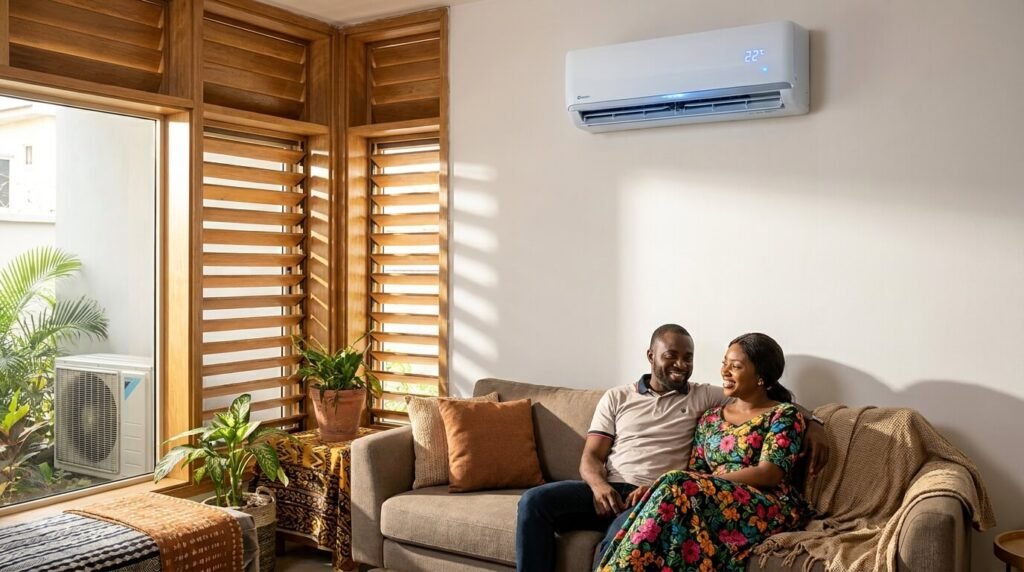
Definition of an Air Conditioner
An air conditioner is a mechanical system that cools indoor air by removing heat and excess moisture from a room and transferring that heat outside.
Think of it as a heat pump running in reverse; it doesn’t generate cold air; it pulls warm air out and replaces it with cooler, more comfortable air.
Brands like Panasonic, LG, Samsung, and Daikin have built their reputation mastering this process at scale.
Primary Functions of an Air Conditioner
Most people think of an AC as just a cooling machine, but it does quite a bit more:
- Cooling indoor air — brings the room temperature down to a comfortable level
- Reducing humidity — dehumidification is crucial in Nigeria’s coastal cities, where the air is thick with moisture
- Improving comfort — regulates the feel of a room, not just the temperature
- Air filtration — the air filter (like those in Panasonic units) traps dust, allergens, and particles, improving indoor air quality according to World Health Organisation standards.
Why Air Conditioners Are Important in Nigeria
Nigeria sits in a tropical climate zone — hot, humid, and relentless for most of the year. This makes home cooling not just about comfort but about health, productivity, and quality of life:
- Hot climate adaptation — temperatures in cities like Kano, Lagos, and Abuja regularly exceed 35°C, making proper cooling essential
- Better sleep quality — a cool sleeping environment directly impacts how well you rest, especially during the dry season
- Improved workplace productivity — the International Labour Organisation links thermal comfort to better work output; office cooling isn’t just a perk, it’s a performance tool.
How Does an Air Conditioner Work?
The Cooling Cycle Explained
An air conditioner works through a refrigeration cycle — a continuous loop of heat absorption and release. Here’s how it goes:
- Heat absorption — the evaporator coil inside your room absorbs warm air from the space, with the refrigerant inside it soaking up that heat
- Refrigerant circulation — the now-warm refrigerant (commonly R-410A) travels to the outdoor unit, carrying the heat with it
- Heat release — the condenser coil outside releases that heat into the outdoor air, and the cycle repeats
This is the refrigeration cycle in its simplest form — the same principle that keeps your fridge cold, just applied to an entire room.
Key Components of an AC System
Every AC system, whether it’s a budget window unit or a premium Samsung split system, relies on these core parts:
- Compressor — the engine of the system; it pressurises the refrigerant gas (Copeland makes some of the most reliable compressors in the industry)
- Condenser — the outdoor coil that dissipates heat into the open air
- Evaporator coil — the indoor coil that absorbs heat from your room; LG Electronics and Panasonic build some of the most efficient ones available in Nigeria
- Refrigerant — the thermal fluid (like R-410A or R-32) that transfers thermal energy through the system
- Thermostat — the control brain; Honeywell thermostats are widely regarded as among the most precise for regulating indoor temperature.
Temperature Regulation Process
The thermostat constantly monitors your room’s temperature. Once the room hits your set point, the compressor either slows down (inverter AC) or switches off completely (non-inverter AC).
This cycle keeps the temperature steady without running the unit unnecessarily, and it’s the key reason inverter technology saves so much electricity.
Types of Air Conditioners for Nigerian Homes and Offices
Nigeria’s market has a wide variety of AC systems, each suited to different spaces and budgets. For a deeper breakdown, check out this complete guide to the types of air conditioners available in Nigeria.
Split Air Conditioners
The split AC is by far the most popular type in Nigerian homes and offices. It has two units — an indoor unit that distributes cool air and an outdoor unit that expels heat.
Brands like Hisense, LG, Panasonic, and Samsung Electronics dominate this space. They’re quiet, powerful, and energy-efficient, making them ideal for bedrooms, living rooms, and office spaces where you need consistent cooling.
Window Air Conditioners
Window ACs are compact, self-contained units fitted directly into a window or wall opening. Midea is one of the most widely available brands for this type in Nigeria.
They’re affordable and easier to install than split units, making them great for small rooms, single offices, or tight budgets.
Portable Air Conditioners
Honeywell and similar brands make portable AC units that can be moved from room to room. They don’t require permanent installation, which makes them flexible for renters or spaces where drilling into walls isn’t an option.
They’re less powerful than split units but work well for targeted, temporary cooling.
Central Air Conditioning Systems
Central AC systems, like those offered by Carrier Global, use a network of ducts to cool an entire building from one unit.
They’re the go-to solution for large office buildings, hotels, and commercial properties in Nigeria.
The upfront cost is high, but the even distribution of cool air across multiple rooms makes them worth it at scale.
Inverter Air Conditioners
Inverter ACs use a variable-speed compressor that adjusts its output based on how much cooling is needed rather than switching fully on and off.
LG Electronics is one of the leading manufacturers of inverter technology globally. These units save electricity significantly compared to traditional models.
If you’re torn on which to buy, this breakdown of inverter vs non-inverter AC in Nigeria will help you decide.
How to Choose the Right Air Conditioner
Choosing an AC isn’t just about picking a brand you recognise. Use this complete AC buying guide in Nigeria to think through what actually matters for your specific situation.
Room Size and Cooling Capacity
This is the most important factor. AC capacity is typically measured in British thermal units (BTU) or horsepower (HP) in Nigeria.
As a rough guide: a 1HP unit suits rooms up to about 12sqm, 1.5HP works for 15–20sqm, and 2HP handles larger living rooms or open-plan offices.
Undersizing means the AC runs endlessly without cooling properly; oversizing wastes energy and money.
Energy Efficiency
Energy Star-rated models and inverter ACs offer better energy efficiency, meaning more cooling per unit of electricity used.
For Nigerian households dealing with high electricity tariffs, especially Band A consumers from Power Holding companies like PHCN or the Eko Electricity Distribution Company (depending on the state you reside in), this matters a lot.
An efficient AC isn’t just good for the environment; it keeps your monthly bills from spiralling.
Electricity Supply Stability in Nigeria
Nigeria’s power grid is notoriously unstable, failing and crashing several times in a year. According to the International Centre for Investigative Reporting, the National grid has collapsed twice in 2026.
Voltage fluctuation is a real threat to your AC unit; it can cause compressor failure and shorten the lifespan of your appliance significantly.
The Nigerian Electricity Regulatory Commission has acknowledged this challenge. Always pair your AC with a voltage stabiliser (Binatone makes widely trusted ones) and consider units with built-in surge protection, like those from APC by Schneider Electric.
An auto-restart feature (available on many Samsung Electronics models) is also essential, as it brings your AC back on automatically after a power outage.
Budget and Installation Cost
Don’t just look at the sticker price. Factor in installation cost, the cost of a voltage stabiliser, and the long-term electricity bill.
A non-inverter AC might save you money upfront, but costs significantly more to run over time.
Generator compatibility is also worth checking if you run your AC on a Honda generator during outages. Make sure the unit’s power requirements match your generator’s output.
Best Air Conditioners for Nigerian Homes
Here’s a look at what works best in different home settings. For specific product recommendations, see our list of the best air conditioners in Nigeria.
AC for Bedrooms
Bedrooms need quiet, energy-efficient cooling; you don’t want a noisy unit disrupting your sleep. Look for inverter split ACs with a low noise level (measured in decibels).
Midea, Samsung, Panasonic, LG, and Daikin’s residential range is known for whisper-quiet operation and sleep mode features that gently raise the temperature as you sleep to reduce power use and prevent overcooling.
AC for Living Rooms
Living rooms are typically larger and have more heat gain from sunlight, TVs, and people. A 1.5HP to 2HP split AC is usually the right fit. Look for models with wide-angle airflow and strong cooling capacity.
Panasonic, Samsung Electronics, and LG Electronics both have popular living room-friendly models available across Nigerian markets.
AC for Small Apartments
In a small apartment, you need space-saving options that don’t drain your wallet. A 1HP split AC or a window unit from Midea can cover most small apartments efficiently.
Prioritise energy efficiency and make sure the unit doesn’t require more power than your apartment’s electrical capacity can handle.
Best Air Conditioners for Nigerian Offices
AC for Small Offices
A small office with 2–4 workstations doesn’t need heavy-duty cooling. A 1HP, 1.5HP, or 2HP split system or even a portable unit from either Samsung, Skyrun, LG, or Panasonic can handle the load.
The key is making sure the unit runs quietly enough to allow focus and communication without distraction.
AC for Large Office Spaces
Larger open-plan offices need either multiple split systems strategically placed for even air distribution or a central AC system. For example, you can have about 3 2HP Panasonic AC units in a large office space, which helps to distribute cooling effectively.
Proper cooling load calculations are essential here; one unit trying to cool a big space will run non-stop, waste electricity, and still leave corners warm.
AC for Commercial Buildings
Hotels, shopping plazas, and commercial properties in Nigeria typically rely on central AC systems from brands like Carrier Global.
These systems are complex, require professional design, and need routine maintenance, but they offer the most even and efficient cooling for high-footfall environments.
Air Conditioner Power Consumption in Nigeria
How Much Electricity Does an AC Use?
Power consumption depends on the AC’s capacity (HP/BTU), the efficiency of the unit, and how long it runs. A typical 1HP non-inverter AC draws about 750–900 watts per hour. Run it for 8 hours a day, and that’s 6–7.2 kWh daily.
With rising electricity tariffs in Nigeria, this adds up fast. Insulation in your room also plays a role; better-insulated spaces retain cool air longer, so the AC cycles less.
Inverter vs Non-Inverter Electricity Usage
Non-inverter ACs (like many Haier models) run at a fixed speed, fully on or fully off. This cycling approach consumes more electricity because starting the compressor draws a surge of power each time.
Inverter ACs regulate their compressor speed, maintaining the set temperature with far less energy. Over a year, the savings are substantial. Inverter units can use 30–50% less electricity than their non-inverter counterparts.
Reducing Electricity Bills While Using AC
- Set your thermostat between 24°C and 26°C — this is the sweet spot for comfort and efficiency in Nigeria’s climate
- Use sleep mode and energy-saving mode at night to reduce power draw
- Keep doors and windows closed when the AC is running to prevent heat gain
- Regularly clean your air filter — a clogged filter forces the unit to work harder, consuming more electricity
- Service your unit every 3–6 months to keep it running at peak efficiency.
Air Conditioner Installation Guide
Choosing the Right Installation Location
For a split AC, the indoor unit should be mounted high on the wall (at least 2.1 metres from the floor) for even air distribution.
Avoid placing it directly above a bed or seating area where the airflow will blow directly onto people.
The outdoor unit needs a well-ventilated spot, ideally shaded, where it can dissipate heat freely. Copper pipes connecting both units should be as short as possible to minimise energy loss.
Professional Installation Importance
AC installation isn’t a DIY job in most cases. Improper refrigerant handling, incorrect electrical connections, or a poorly positioned indoor unit can reduce performance and create safety hazards.
Hire a certified technician who understands the correct use of copper pipe, drain pipe, and installation brackets.
Brands like Hisense often have certified installation partners across major Nigerian cities.
Common Installation Mistakes
- Poor drainage setup — the drain pipe must slope downward from the indoor unit to drain condensate water properly; a blocked or upward-sloping drain causes leaks and water damage. This doesn’t mean this type of AC uses water.
- Wrong positioning — placing the indoor unit too low, too close to a corner, or directly in sunlight reduces its efficiency significantly.
- Skipping wall mounting reinforcement — installation brackets must be secured into solid wall material, not just plaster.
Air Conditioner Maintenance Tips
Cleaning Filters Regularly
The air filter is your AC’s first line of defence. In dusty Nigerian environments, it gets clogged quickly.
A dirty filter restricts airflow, forces the unit to work harder, and reduces cooling efficiency. Clean the filter every 2–4 weeks, depending on usage. Most Panasonic and LG split AC filters slide out easily and can be rinsed with water and left to air dry.
Servicing the AC Unit
Beyond filter cleaning, your AC needs a full routine maintenance check every 3–6 months. A technician will clean the evaporator coil, check refrigerant levels, inspect electrical connections, and clear the drain pipe.
Regular servicing prevents small issues from becoming expensive repairs, particularly compressor failure, which is one of the most costly AC repairs in Nigeria.
Checking Refrigerant Levels
If your AC is cooling poorly despite a clean filter and proper settings, low refrigerant could be the issue. A gas refill restores cooling performance.
This requires a licensed technician in Nigeria; the common refrigerants are R-410A and R-32. Never ignore refrigerant leaks; they don’t just affect performance, they’re also environmentally harmful.
Common Air Conditioner Problems in Nigeria
Poor Cooling Performance
This is the most common complaint. The culprits are usually a dirty air filter blocking airflow, low refrigerant from a slow leak, or the wrong AC size for the room. Start with the filter, then call a technician to check refrigerant levels.
If the AC was always underpowered for the space, no amount of maintenance will fix that; you’ll need a higher-capacity unit.
High Electricity Bills
Unusually high bills from running your AC often point to an inefficient unit, an oversized or undersized AC struggling to maintain temperature, or poor usage habits.
Check that you’re using the right thermostat settings, that your air filter is clean, and that the unit is correctly sized for your room. If you’re still on a non-inverter unit, upgrading might save you significantly in the long run.
Power Fluctuation Damage
Voltage fluctuation from Nigeria’s grid is responsible for a significant share of AC breakdowns in the country. Sudden power surges can damage the compressor or the electrical board, leading to costly repairs.
Always use a quality voltage stabiliser from a trusted brand like Binatone, and consider an AC with built-in power surge protection. It’s a small upfront investment that protects a much bigger one.
Common Mistakes to Avoid When Buying an AC
Buying the Wrong Capacity
Picking an AC based on price alone without matching it to your room’s cooling load is one of the most expensive mistakes you can make.
An undersized unit runs non-stop and never quite cools the room; an oversized one short-cycles (turns on and off too frequently), struggles with humidity control, and wears out faster.
Always size based on room dimensions, heat gain from sunlight, and how many people occupy the space.
Ignoring Energy Efficiency
A cheap, inefficient AC might look like a bargain at the point of purchase, but it’ll cost you more in electricity over its lifetime than a premium energy-efficient model would have.
In a country with Nigeria’s electricity costs and supply challenges, energy efficiency isn’t a feature — it’s a financial decision.
Choosing Cheap Installation Services
Cutting costs on installation is a false economy. A poorly installed AC with a badly positioned indoor unit, improper refrigerant charge, or substandard wall mounting will underperform from day one. It may also develop faults faster, costing you more in repairs.
Spend what it takes to get it done right the first time.
Conclusion
Air conditioners are no longer optional for Nigerian homes and offices; they’re essential tools for comfort, productivity, and better living in a hot, humid climate.
Understanding how your AC works, the types available, and what to look for when buying one puts you in control of a decision that affects your daily comfort and your monthly electricity bill.
Take the time to match your AC to your room size, factor in Nigeria’s power supply realities, and commit to regular maintenance.
A well-chosen and well-maintained air conditioner will serve you reliably for years and keep you cool no matter what the weather outside has to say.