
Most homeowners only start looking for signs your AC needs replacement after a repair bill stings more than expected, or a hot afternoon makes an airflow problem impossible to ignore.
The honest answer sits between two extremes: not every odd noise means a new unit, and not every aging system deserves another $400 repair.
Twelve signals separate a fixable problem from a system that’s done. Age, repair frequency, and energy bills matter most.
But 2026 adds two factors most guides skip entirely: a refrigerant rule that changed in January 2025, and a federal tax credit that quietly expired in December 2025. Both affect what replacing your AC actually costs right now.
Physical and performance warning signs
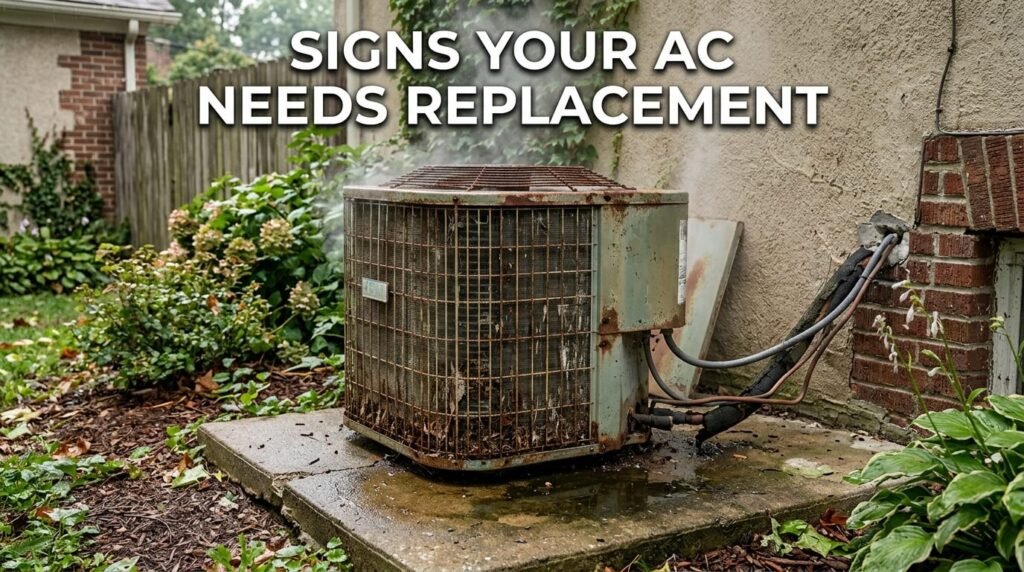
The clearest signs you need a new air conditioner show up in how the system sounds, feels, and runs, not just in its age.
Before calling anyone, it helps to know the average AC repair cost by issue, since that number feeds directly into the decision math later in this guide.
Four categories cover almost every complaint a technician hears.
Strange or loud noises from the unit
- A high-pitched squeal usually points to a worn-out blower motor or a failing belt, and it gets louder the longer you wait.
- Grinding or scraping sounds often mean a bearing has gone bad inside the motor, and motors rarely survive that for long.
- Clicking that continues after startup, not just the relay click at power-on, can signal an electrical control problem.
- Banging from the outdoor unit is frequently a loose or broken part inside the compressor. One of the costliest single repairs an AC can need.
Warm air or inconsistent cooling
- Air that feels warm or barely cool usually traces back to a failing compressor, a refrigerant leak, or a frozen evaporator coil.
- A clogged air filter causes the same symptom on a unit under 10 years old, so rule that out before assuming the worst.
- Some rooms staying noticeably hotter than others points to airflow or ductwork problems rather than the unit itself, though an aging system makes the imbalance worse.
- A system that runs constantly without ever reaching the thermostat setting is straining components that weren’t built to run nonstop.
Water or refrigerant leaks around the unit
- A clogged condensate drain line backs up and drips water near the indoor unit, the same way an overflowing sink would.
- Oily residue or a hissing sound near the outdoor unit usually means a refrigerant leak, which is a health and environmental concern, not just a performance one.
- Cracked drain pans or corroded coils let water escape into places it shouldn’t, and that damage gets worse with another season of use, not better.
- Recurring leaks on a system older than 10 years argue for replacement, since the parts causing the leak are often near the end of their own service life anyway.
Rising energy bills with no change in usage
The EIA reports that air conditioning accounts for 12% of total home energy expenditures (nationwide) and 27% of home energy expenditures in the hot-humid region, but these figures refer to total energy costs (including heating, water heating, etc.), not just the monthly power/electricity bill
If your bill has climbed and your habits haven’t changed, an aging system working harder to produce the same cooling is the likely cause.
A clean filter and a recent tune-up rule out the easy fixes first. After that, a 15% to 20% increase with no clear cause is a number worth acting on.
Another important area we miss at times is this: When you put on your AC unit, and the compressor trips off the Electrical breaker too often, even after repair, maintenance, or servicing, then, based on my experience, we recommend you replace the air conditioning unit.
Age-related signs your AC is near the end of its life
The single biggest age threshold to know: once a central AC passes 12 to 15 years old, repair costs start outweighing what a new system would cost over the same stretch, and that’s before counting how much less efficient the old unit already is.
How long do central air conditioners actually last
| System type | Typical lifespan |
|---|---|
| Central split-system AC | 12–17 years |
| Heat pump (cooling mode) | 10–15 years |
| Window or portable AC | 8–10 years |
| Central AC, well-maintained, mild climate | Up to 20 years |
Climate plays a bigger role than most people expect. A system running nine months a year in Phoenix or Houston ages faster than the same model in Seattle, which is exactly what this central air conditioner lifespan by climate breakdown covers in more depth.
Why a unit past 15–20 years should be replaced, not repaired
A unit past the 15-year mark isn’t just old; it’s running on parts a manufacturer may have stopped making years earlier.
Finding a matching compressor or control board for an 18-year-old system can take longer and cost more than the part itself would suggest, and some repairs aren’t available anymore at any price.
Efficiency drops with age even when nothing looks broken: a 20-year-old unit commonly runs 20% to 40% less efficiently than a current model, based on Department of Energy efficiency comparisons.
That gap shows up every month on the power bill, whether or not the system ever makes a strange noise.
Stretching the last few years out of an older system is possible if you stay on top of upkeep; skip that, and the timeline shortens fast. This
The AC maintenance checklist covers exactly what that upkeep looks like.
How to tell if it’s a repair or a replacement
Two numbers answer this question more reliably than any single symptom: the age of your system, and the cost of the repair sitting in front of you.
The $5,000 rule, and why it needs a 2026 update
The $5,000 rule: multiply your AC’s age in years by the estimated repair cost in dollars. A result above $5,000 favors replacement. Below that, repair is usually still worth it.
| Scenario | Math | Result |
|---|---|---|
| Classic textbook example | 10 years × $600 repair = $6,000 | Replace |
| Classic textbook example | 10 years × $300 repair = $3,000 | Repair |
| A realistic 2026 repair | 12 years × $1,000–$2,000 repair = $12,000–$24,000 | Replace, clearly |
That third row is the one most articles skip. Labor alone now runs $75 to $250 an hour, and a compressor- or refrigerant-related repair on an older system usually needs several hours plus parts, based on ConsumerAffairs’ 2026 pricing data.
Refrigerant costs have moved even further: cylinder prices for the newer A2L refrigerants have climbed more than 300% in some markets as supply struggles to keep pace with the post-2025 manufacturing shift. The next section covers exactly why.
A repair that ran $600 a decade ago routinely lands closer to $1,000 to $2,000 now. Run the math with today’s numbers and the $5,000 rule still works; it just points to replacement faster than it used to.
Some contractors use a simpler version of the same idea: if the repair costs more than 50% of a full replacement, replace.
Average cost to replace a central AC unit in 2026
| Efficiency tier | SEER2 rating | Typical installed cost |
|---|---|---|
| Entry-level (federal minimum) | 13.4–14.3 SEER2 | $3,500–$6,500 |
| Mid-efficiency | 15–17 SEER2 | $6,500–$9,500 |
| High-efficiency, variable-speed | 18+ SEER2 | $10,000–$15,000+ |
The federal minimum efficiency standard is 13.4 SEER2 in the South and Southwest and 14.3 SEER2 in the North, under the Department of Energy’s 2023 update.
Even the cheapest legal option today outperforms a 10 SEER unit from the early 2010s by a wide margin.
A 16 SEER2 system tends to be the sweet spot between upfront cost and long-term savings for most homes; pushing past 20 SEER2 only pays off in climates that run cooling six months or more a year.
The 2026 refrigerant rules that change the replacement math
Skip this section, and you’ll make the repair-or-replace call with outdated information.
The R-410A phase-out timeline most homeowners know about stopped at the 2020 ban on R-22.
R-410A, the refrigerant in almost every central AC installed over the last 15 years, is now going through its own transition, in three overlapping stages, most buyers never hear about until they’re mid-purchase.
Why are R-410A repairs getting more expensive?
R-22 refrigerant (Freon) was banned from new equipment back in 2010 and fully phased out by 2020. That part is old news, and most competing articles stop there. R-410A is following the same path, just years behind.
| Date | What happened | What it means for you |
|---|---|---|
| Jan 1, 2025 | EPA’s AIM Act rule bans manufacturing or importing new residential R-410A air conditioners and heat pumps | No new R-410A equipment can be built after this date |
| Jul 27, 2026 | A separate EPA rule takes effect, allowing installation of units manufactured before Jan 1, 2025 until existing stock runs out | A “new” system installed this year could still be a pre-2025 R-410A unit, not A2L |
| 2025–2026 | A2L refrigerant (R-454B) supply shortages | Cylinder prices for the newer refrigerant have risen over 300% in affected markets |
| Jan 1, 2028 | Manufacturing cutoff extends to R-410A package units | Affects a smaller share of residential installs |
| By 2036 | AIM Act target: 85% cut in HFC production from baseline levels | The phase-down continues regardless of any single purchase |
What the EPA’s 2026 installation rule means for buyers
This affects a decision you might be making this year. If a contractor quotes a system built on R-410A, ask when it was manufactured.
Equipment built before January 1, 2025, is legal to install under the EPA’s July 2026 rule, and it can be cheaper and easier to service than a brand-new A2L system caught in the current refrigerant shortage.
The newer A2L equipment isn’t a bad choice — it’s the direction the entire industry is moving. But “newer” doesn’t automatically mean “cheaper to own” in 2026. Ask for the manufacture date and compare warranty terms before deciding either way.
Does the federal tax credit still apply in 2026?
No, and this is the gap that costs people the most money if they don’t catch it before buying. Many older articles still describe the federal credit as expired at the end of 2025.
For a full breakdown of the current HVAC tax credits and rebates still on the table in 2026, the next two sections cover exactly what changed.
What expired (Section 25C) and when
| Credit | 2026 status |
|---|---|
| Section 25C — Energy Efficient Home Improvement Credit | Expired Dec 31, 2025 under the One Big Beautiful Bill Act |
| Section 25D — Residential Clean Energy Credit | Also expired Dec 31, 2025 |
| Up to $2,000 for qualifying heat pumps | No longer available for systems installed in 2026 |
| Systems installed and placed in service by Dec 31, 2025 | Can still be claimed on a 2025 tax return |
If a contractor mentions a federal tax credit as a reason to buy now, that’s a 2025-era pitch. It doesn’t apply in 2026.
State and utility rebates that still exist
- Many state energy offices run efficiency rebate programs that operate independently of federal tax law, so the federal expiration doesn’t shut these down.
- Local utility companies frequently offer point-of-sale discounts or bill credits for high-efficiency installs, and these vary by provider rather than by state.
- IRA-funded state rebate programs tied to home energy assessments are still rolling out in some states, on a separate timeline from the expired federal credit.
- A licensed contractor in your area will know which of these currently apply to your address — worth a five-minute question before you sign anything.
When to replace — timing and a final decision checklist
Timing changes both the price you pay and how much choice you have, even when every other factor points in the same direction.
Best time of year to replace your AC
Spring and early fall are the cheapest times to replace a central AC, because contractor schedules open up once the summer rush ends and before the next one starts.
Waiting for a breakdown in July puts you at the mercy of whatever inventory a contractor has on hand and whatever installation slot is open that week — neither tends to favor the homeowner.
If your system already shows two or more of the signs covered above, scheduling a replacement before the next cooling season starts is the cheaper, calmer path, even if the unit is still technically running.
A quick checklist before you call a contractor
- Confirm the age of your system from the manufacturer date on the outdoor unit’s nameplate, not your best guess.
- Get a written repair estimate, then run the age-times-repair-cost math from the $5,000 rule above.
- Ask whether the quoted system uses R-410A or a newer A2L refrigerant, and if it’s R-410A, ask for the manufacture date.
- Check whether a state or utility rebate applies to your address before assuming the quoted price is final.
- Get at least two quotes if the repair-or-replace math is close — installed pricing varies more between contractors than most homeowners expect.
If two or more of the signs above match what you’re seeing, the next useful step is a written quote, not another guess.
A licensed technician can confirm the age, the refrigerant type, and the real repair cost in one visit- everything you need to run the numbers for yourself.
FAQ
How do I know if my AC needs to be replaced or repaired?
Run the $5,000 rule: multiply the system’s age by the estimated repair cost. A result above $5,000 favors replacement; below that, repair is usually still worth it.
What is the $5,000 rule for AC replacement?
Multiply your AC’s age in years by the dollar cost of the repair it needs. A result over $5,000 points to replacement; a result under $5,000 points to repair.
How long do central air conditioners typically last?
Most central systems last 12 to 17 years, with well-maintained units in mild climates reaching 20 years. Heavy use in a hot climate shortens that range.
Is it worth repairing a 15-year-old AC unit?
Only for inexpensive, one-time fixes like a capacitor or thermostat. For a compressor failure or refrigerant leak at that age, the $5,000 rule almost always favors replacement.
Why is my AC running but not cooling the house?
The most common causes are a failing compressor, a refrigerant leak, or a frozen evaporator coil. A clogged filter causes the same symptom on units under 10 years old, so rule that out first.
Is R-410A being phased out, and does that affect my AC?
Yes. New R-410A equipment manufacturing has been banned since January 1, 2025, though pre-2025 inventory can still be legally installed under a July 2026 EPA rule. Existing R-410A systems can still be serviced and recharged; only new manufacturing has stopped.
Can I still get a tax credit for a new AC unit in 2026?
No. The federal Section 25C credit expired December 31, 2025, and doesn’t apply to systems installed in 2026 — check state energy office and utility rebate programs instead.
What happens if I keep repairing an old AC instead of replacing it?
Repair costs climb as parts get harder to source for older systems, and efficiency keeps dropping every year regardless of maintenance. Eventually, the cumulative repair cost passes what a replacement would have cost from the start.
Should I replace my AC before summer or wait until it fails?
Replace before summer if the system already shows two or more warning signs, since spring and fall installs are cheaper and faster to schedule. Waiting for a mid-summer breakdown removes your ability to compare quotes or wait for the best price.